
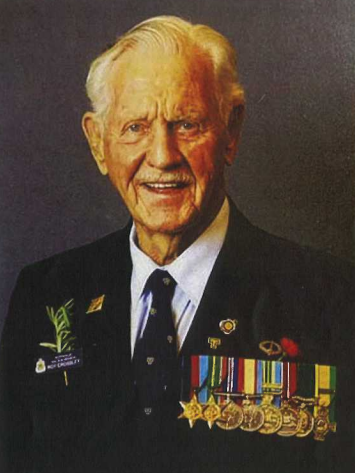
Roy Crossley
🎖️ Roy Remembers — From Childhood to Manhood
When I was twelve my parents separated and my mother could not afford to keep my twin brother and myself, so as I was a big strapping lad I was sent to Bathurst to work on a sheep station. There were no women there, the men were pretty rough and I had to fend for myself a lot of the time. If there was no work I had to go rabbiting, as you didn't get fed if you didn't work. I did learn to shoot very well, so was a good marksman in the Army. This is just to give you an insight as to how I was able to join the Army at a young age without a great deal of difficulty. The Army was a bit of a breeze with three square meals a day, warm clothing, and the training wasn't that hard after the life I had been living.
In May 1941, at the age of 14 and 8 months, I came to Sydney and attempted to enlist in the AIF, but failed. Three more times I was knocked back for being underage, but I was eventually accepted into the Army (Militia) on 9 May 1941. I was then posted to the Coastal Defence. After basic training at Middle Head I was given instruction on 3-inch anti-aircraft guns. My first posting was with an anti-aircraft unit and we were to go to Rabaul. Early July saw me on embarkation leave, and on reporting back to barracks I was feeling unwell. It was discovered that I had the mumps. I was admitted to Prince Henry Hospital and whilst I was in there my unit sailed for Rabaul. This proved to be very fortunate for me, as almost my entire unit was wiped out. Of the 57 men, only 5 came home, and these men had to trek out through the jungle. They spent a total of three months before they were taken off by a US patrol boat. During this time I was awaiting orders to rejoin my unit, but they never came, so I was sent to Port Kembla. Here I trained on 3.7 anti-aircraft guns. I was a gun-layer and was involved in the first day and first night shoots. Whilst I was at Port Kembla, Japan entered the war.
When Japan entered the war I applied for a transfer to the AIF but was refused. My next step, when on leave in January 1942, was to dress in civilian clothes and go to Martin Place, where I joined the AIF under a different name. It was now 13 January 1942 and I was 15 and 3 months. My posting was in Dubbo with the 19th Battalion Reinforcement Company. This unit was being sent to Malaya to join the 8th Division. We had two months of training and were ready to embark when news came of the fall of Malaya. I must have had a guardian angel, as this unit was to have been in Malaya. Those who survived the attack were taken prisoner and worked on the notorious Burma Railroad. As Malaya had now fallen, we were sent into another theatre.
We entrained to Cairns on 27 March 1942 and within the week were on our way to Port Moresby on the SS Taroona. The unit we were joining was the 53rd Battalion. Our duty was to defend the Moresby aerodrome, which was commonly called Seven Mile Aerodrome. We manned Lewis guns against the Japanese fighters who were accompanying their bombers. They flew over and dropped their bombs at about 1100 hours each day, followed by strafing from the Zeros. Our guns were fairly ineffectual, but they were the only defence we had, as there were no fighter planes in the area until the Americans sent in P-40s — which we nearly shot down as they buzzed the aerodrome to herald their arrival. After about two months I contracted dysentery and was sent to a special camp for this illness, the only treatment being beef tea for days.
I was evacuated home on the 2/2 hospital ship Wanganella. We sailed on 4 June 1942; I was 15 and 8 months and already a returning veteran. In September, whilst recuperating in Concord Hospital (113 AGH), my mother informed the authorities that I was only 15, and so I was discharged on 15 October 1942, having just turned 16.
On 28 April 1943, after a slow convalescence, I again joined the AIF — this time under my own name. I did this although I was only 16 and didn't have my birth certificate, as I had been born in Perth. This they accepted, and then it was off for more training. This time I commenced at Cowra and then moved on to the Atherton Tablelands. I spent the next ten months up there training in divisional exercises before shipping out to Morotai on the Dutch freighter Both, manned by a native crew. I was so sick on the eleven-day trip up the New Guinea coast that I was hoping the Japanese would torpedo the ship so I could swim to shore. Here we spent the next three weeks preparing for the invasion of Borneo.
In June we shipped out on HMAS Kanimbla and landed by landing craft on Green Beach, Brunei Bay. Our first major action was taking Brunei Town. On the second night we were shelled by mortar fire and suffered some casualties, whom we carried out to awaiting jeeps for evacuation. We then had to find our way back to our lines on the blackest of nights, deeming ourselves lucky not to be shot by our own troops — as usually anything that moved was killed. Filthy, dirty, sweaty and tired, we lived in our trenches by night and advanced by day to a new position. We couldn't sleep at night due to the continuous firing and the grenades that were thrown at every little noise. We were very leery of any movement in front of us.
After taking the town on 13 June we dug in at a local mosque, which enabled us to wash ourselves and our clothes, which were beginning to smell rather badly. After securing the area, vehicles were brought in to advance us along the 70-mile beach to Seria. This became the fastest advance in the Pacific War. Here we found 27 oilfields alight. Day and night became the norm; the skies were lit up for weeks. Our next task was Labuan Island, where we received prisoners of war, whom we treated medically before they were returned to Australia. They were in a pitiful condition, suffering from malnutrition, beri-beri, malaria, tropical ulcers and any other disease known to the tropics.
We moved on to Morotai for a couple of months before returning to Australia on the British LST 324. I arrived home on 11 January 1946 and was most miffed at missing all the victory celebrations. On my return I spent time at Victoria Barracks before finally being discharged on 23 June 1946. I was 19 and 9 months and had spent a total of four and a half years in the Service. After discharge I later joined the CMF and served 15 years with 5 Field Ambulance, reaching the rank of Transport Sergeant.
📜 Service Record
Roy enlisted three times — twice under assumed names — to get around being underage.
| Service No. | Rank & Name | Enlisted | Discharged |
|---|---|---|---|
| N27064 | Gnr Roy Crossley | 9 May 1941 | 13 Jun 1942 |
| NX83660 | Pte Roy Lindsay | 13 Jun 1942 | 8 Oct 1942 |
| NX171970 | Pte Roy Crossley | 4 Jun 1943 | 21 Jun 1946 |
| 2/127036 | Sgt Roy Crossley | 1947 | 1966 (not all continuous) |
🌿 A Family at War
Roy's half-brothers, the McFarlanes, all served:
John McFarlane (WX7227) — 1 Aug 1940 to 20 Jun 1945, 2/6 Field Park Company. John was taken prisoner when Singapore fell and died on the death march at Sandakan.
Clement McFarlane (WX4975) — 23 Jul 1940 to 26 Nov 1945, 2/28th Battalion AIF, 9th Division. Clem was a Rat of Tobruk and also saw service in New Guinea and Borneo.
Dixie McFarlane (WX7199) — 31 Dec 1941 to 19 Dec 1945, 172 Aust Lt AA Battery. Service history unknown.
Thomas McFarlane (T155705) — from 30 Dec 1942, Volunteer Defence Force.
💛 Life with a Legend
Roy was so much more than his service career, which has been discussed numerous times. I'll try to give you a little insight into the man and our life together, mainly from my point of view — which only takes in the last 37 years.
We began this journey in 1984, when we started what was to become a lifelong love affair. For the next ten years — Roy in Sydney, myself in Brisbane — we were able to keep our romance blossoming, taking occasional ski or beach holidays when work permitted. My children were still teenagers and I had the misguided opinion that they needed me. The catalyst came after we had holidayed in Hawaii and discussed maybe making it permanent. In 1995 I left home, and the most amazing adventure was about to begin.
I was 54, my life seemingly behind me, children raised, grandchildren growing up. Oh, how wrong I was. Roy not only gave me unconditional love and happiness, but above all he gave me back my youth. A whole new world opened up for me — for us — and we embraced it with open arms.
During our travels in the Northern Rivers we came across a little beachside village called Pottsville and thought it would be an ideal place to live — a decision we never regretted. We settled on a house on the canals and decided this was where we would see out our days. Although we were settled, we still managed to do quite a bit of travel. We skied in Canada, Colorado and New Zealand. It was in Bali, at the age of 83, that Roy decided he'd like to do another dive; he had a practice in the pool, felt confident, and was thrilled to dive a WWII shipwreck and an underwater volcano. The last big trip we did was to England, Scotland and Paris, for my 70th — we both loved it and regretted not going earlier, as both our roots are in the mother country.
Roy was a passionate man, not only in love but in life and everything he tackled. I think it was due to the fact that he went without so much as a child — not only material things, but feeling unloved and rejected, with no sense of belonging. As an adult, when something took his interest, he gave it his all: he read, he learnt, he practised, bought the equipment, and threw himself at it 100%. The children speak of their first holidays camping at Norah Head — just a week's holiday, but the next year they went with a boat, a full-sized fridge and a Taj Mahal of a tent, and stayed for six weeks. He taught them to skin-dive. They were living the childhood he had been denied.
His next venture was hang-gliding with his oldest son. Maybe at 50 this wasn't such a great idea; he crashed his kite at Stanwell Park, breaking his femur in five places and breaking his arm. The doctors put him back together again and he was walking in three weeks. Snow skiing, a less dangerous activity, then became his passion — Switzerland, Colorado and California. Apart from me, it was the love of his life. He had his last ski at Hotham at 84, though I think he spent more time in the coffee shop than on the slopes.
He was well known for his fitness, always with a home gym, and at 93 was still attending the gym, mainly for the bike and balance class. Roy was a family man — he would rather be with his wife, children and grandchildren than out with mates. He taught his children all the fun things: diving, skiing, hang-gliding, driving, fishing, roller-blading. He gave his love and his time, and he reaped the benefits later in life when his children enjoyed spending time with him. Throughout all the years he remained true to his service, rarely missing an ANZAC Day, proudly donning his suit and medals to go and march, reminisce and remember his mates.
Roy is survived by his wife, four children, eleven grandchildren and six great-grandchildren.